
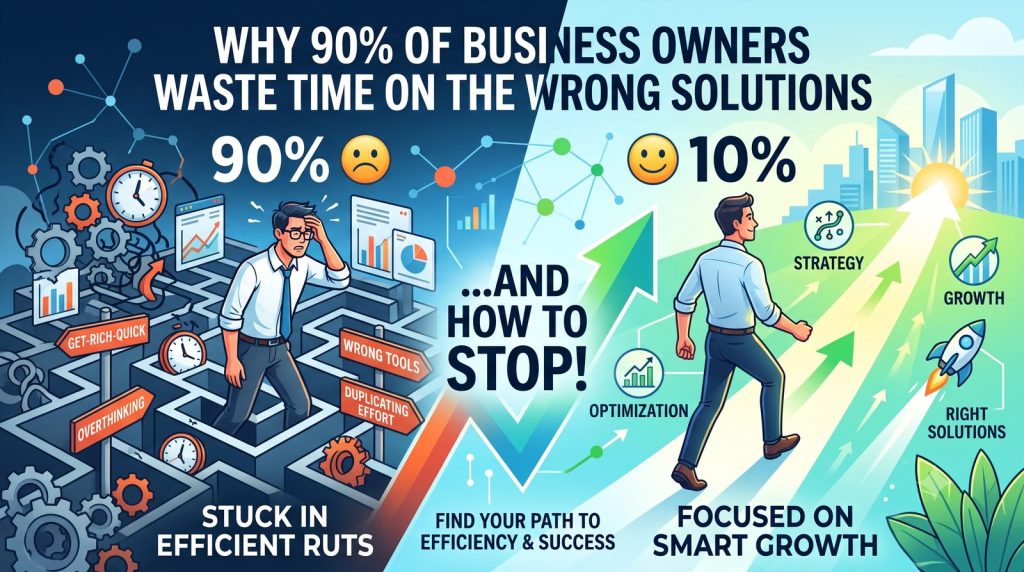
Every year, business owners spend thousands of hours and thousands of dollars chasing the wrong solutions. Not because they’re careless — but because most of the advice out there is generic, most “quick fixes” don’t account for context, and most decisions get made under pressure rather than with clarity.
At The Smart Tier, we work with businesses at every stage — from brand-new startups to established companies looking to scale — and we see the same costly pattern repeat itself over and over. This article breaks down exactly what that pattern looks like, why it happens, and the framework we use with our own clients to avoid it entirely.
The Pattern: Why 90% Get It Wrong
The average business owner cycles through 8 to 11 different tools, services, or strategies before landing on something that actually moves the needle. That’s not a guess — it’s what we consistently observe when new clients walk us through their history before working with us.
Here’s what that cycle usually looks like:
- The panic decision. Something isn’t working — sales are down, growth has stalled, engagement is dropping — and a decision gets made fast, based on whatever solution is most visible at that moment (usually whatever is being aggressively marketed).
- The shiny object trap. A competitor mentions a tool or tactic that worked for them, and it gets adopted without asking whether the underlying business, audience, or goals are actually comparable.
- The sunk cost spiral. Money and time have already been invested, so instead of cutting losses early, more gets poured into a solution that was never going to work for this specific business.
- The generic advice trap. Broad, one-size-fits-all advice gets applied without adapting it to the specific stage, niche, or constraints of the business.
Each of these decision points feels reasonable in the moment. That’s exactly what makes the pattern so expensive — it doesn’t feel like a mistake until months later, when the results simply aren’t there.
The Real Cost of Getting It Wrong
The financial cost is only part of the story. The bigger cost is almost always time — the months spent on a strategy or tool that was never going to deliver, time that could have been spent on something that actually worked. For a growing business, that lost time often matters more than the money.
“The businesses that grow fastest aren’t the ones that make the most decisions — they’re the ones that make fewer, better decisions and stick with them long enough to see results.”
There’s also a compounding trust cost. Every failed solution makes the next decision harder, because confidence erodes. Business owners who’ve been burned by a few bad tools or agencies often become overly cautious — which can be just as damaging as moving too fast, because it leads to inaction at exactly the moments when action is needed most.
The Smart Tier Framework: How to Choose the Right Solution the First Time
After working across e-commerce, content, trading, and channel growth, we’ve distilled the decision process into four steps that consistently produce better outcomes. This is the same process our team applies internally before recommending any service, product, or strategy to a client.
1. Define the Actual Problem, Not the Symptom
“Sales are down” is a symptom. The actual problem could be traffic, conversion rate, product-market fit, pricing, or retention — and each of those requires a completely different solution. Spend time diagnosing before you spend money solving.
2. Match the Solution to Your Specific Stage
A tactic that works for a business with 100,000 monthly visitors will often fail for a business with 500. Scale, audience size, and available resources all change what “the right solution” looks like. Always ask: is this proven at my current stage, not just proven in general?
3. Verify Before You Commit
Look for evidence beyond marketing claims — case studies with real numbers, references you can actually speak to, and a trial period or way to test on a small scale before fully committing. If a provider resists giving you any of this, treat it as a signal.
4. Set a Clear Timeline and Decision Point
Before starting anything, decide in advance how long you’ll give it and what result you need to see to continue. This removes the emotional decision-making that leads to sunk cost spirals, and gives you permission to walk away early if something clearly isn’t working.
Bringing It Together
None of this requires more effort — it requires a different order of operations. Diagnose first, match to your stage second, verify third, and set a clear timeline fourth. Businesses that follow this simple sequence consistently make fewer wrong bets and see results faster, because every decision is grounded in their actual situation rather than generic advice or panic.
This is exactly the approach we bring to every client relationship at The Smart Tier — whether it’s marketing, channel growth, or any other service we offer. If you’re currently facing a decision like this and want a second opinion before committing time or money, we’re happy to talk it through with you, free of charge.